The Strategy Is Not the Model
Technical teams build for clinicians instead of with them, governance drifts into an academic exercise, and the real risk sits in the gap between clinical and operations that neither one owns. Notes from the data side of healthcare on what actually moves adoption.
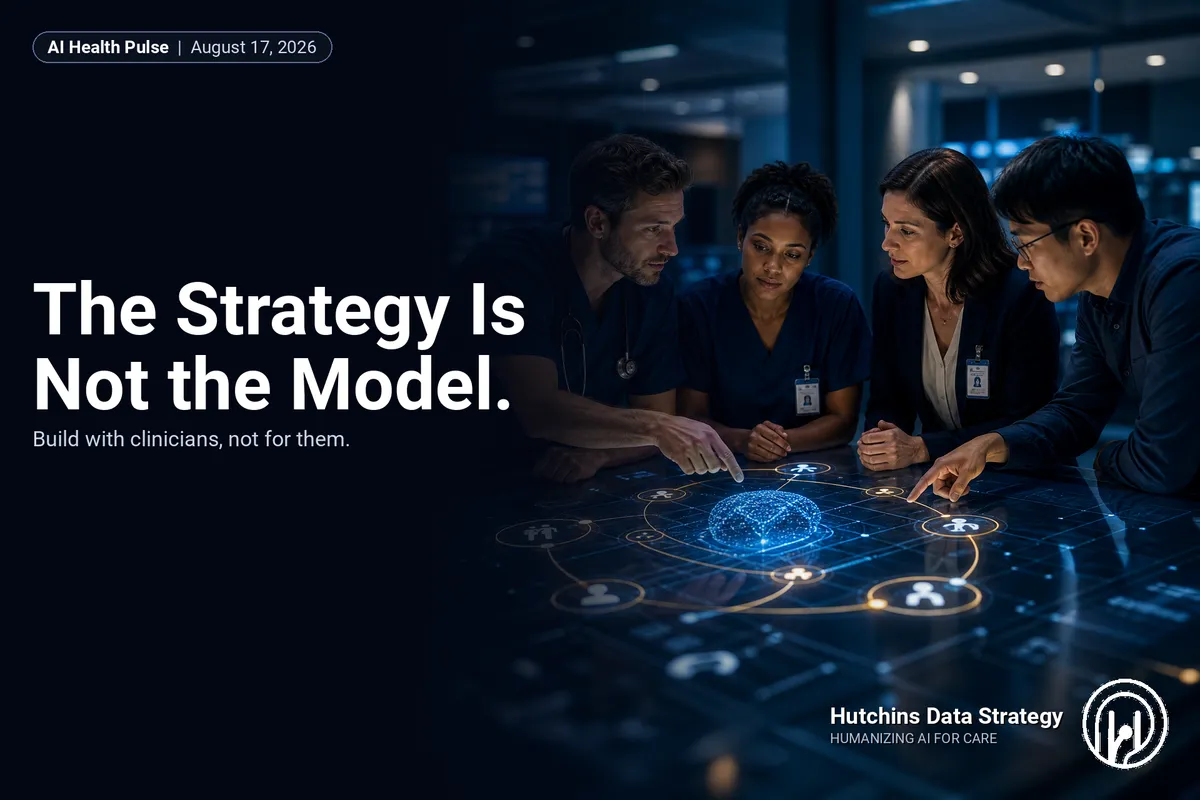
Being on the more technical and data side of healthcare, I think there’s a level of misunderstanding when it comes to adoption of this stuff. Technical people get really excited about cool stuff, but at the end of the day, how many of the things we develop as hobbyists and try to force on our clinical people are actually supporting the real mission? Is it actually making things easier? Is it giving clinicians more time with the patient? These are the things we’ve got to dial in, and we’d better do it quickly, because AI is moving faster than any industry and in healthcare it is of the utmost importance that we get our act together.
One of the things I have told a couple of chief innovation officers I have worked with over the years is that they are really good at solving difficult problems, but the challenge I see is that they are not always asking the people who need the solutions the most. They are doing some cool stuff, and I don’t argue that. But ask a physician what their pain points are and they have a list. We really have to stop taking the approach that we will build it for them. We have to build it with them.
There is also a reality that I don’t think people are cognizant of many times. There is an expectation that an executive running an organization should understand things that others have spent an entire twenty-year career developing the skill set and knowledge to do. It is a misplaced expectation of who is responsible for understanding enough to make good decisions. As a chief data officer, I had to figure out what level of information could inform the CIO to go ask for budget. I might have to dial it in differently for the chief operating officer, who had less understanding of the technology and needed facts that could be verified and trusted. It was on the people working in the trenches to provide the information those leaders needed to execute or to tell us, look, this isn’t going to work.
When I think about governance as an enabling function, this is really what I am talking about. You need the different perspectives in the room to make sure you are asking the right questions and solving the right problems. Oftentimes there is an initial survey or a listening session where a few takeaways are identified. Then people go away and build something in a vacuum and come back to find a surprise waiting for them because it is not actually meeting the need they thought they were trying to address. This has to be an involvement and a relationship that is actually engaged. When you are dealing with AI, the model may continue to be trained or updated, the workflow may change and new things will come up that no one anticipated. There has to be a functional cycle that accompanies development, deployment and the ongoing operation of the solutions we put in place.
Ownership gets interesting because there are so many angles to it. There is the process, the data, the process owner and the governance, and I have seen what happens when governance is approached as an academic exercise. The next thing you know, the discussion is two or three levels down from the person who really owns the decision. It is a cliché, but if everyone owns it, no one owns it. If you are in operations and I am in the clinical space, I have a good sense of what information I can put into a model without exposing anything from a HIPAA standpoint. Independently, the operations people have the same sense and are comfortable they will not put the wrong things out there. But the gap is the piece neither is responsible for, and there is risk there because, as I am sure you have seen happen inadvertently with generative AI, it is very likely to try to find a bridge for that. If it finds that bridge, everything becomes exposed and it introduces risk.
The CFO conversations are the really challenging ones to frame, because the things we are talking about are actually reducing risk, reducing readmission rates, reducing costs, but things that are not on the P and L. You can tell me you are going to reduce length of stay, but I have to budget the way things are actually flowing today. It is a really hard hurdle to clear, particularly with something like a hospital-acquired condition. They will give you credit for the last day, the lowest-cost day, when you are leaving, if you have done something to influence it. But in reality the cost explodes as soon as that acquired condition occurs, and then it goes flat for an extended period. That is a massive cost that does not fit the model they like to use, which is the normal admission. They come in sick, they have a procedure, a few days later they are gone, no complications. That is what they model for you.
I would probably want to advocate for the one measure I am pretty sure people would want. Look, we are reducing mortality. This is not a calculation. You want to meet the people we save? We can do that. It is a quality-of-care and outcomes conversation, and for goodness' sake it is a public-relations boost if you are getting a reputation like that. This is the kind of conversation that should be happening within organizations, and when you have a chance to educate a board, that is a great opportunity you should not miss. Similarly with CFOs, most of them are very passionate, but you really have to figure out their language so they can get what you are saying and figure out how far they can trust it. That trust piece is where it gets a bit tricky when you do not have a guaranteed bottom-line number to give them.
There are a lot of people who are going to throw up the caution flags, and I love that they do. I do not need to do that. What I have to find are the things we can say yes to that are actually going to make a difference and start to relieve the burden and pressure that takes clinicians away from what they went into medicine for, to help people, not to work in the EHR and key things in while the patient is probably annoyed because they are not getting the face time they used to.
One of the things I have experienced myself is that I have been working in an AI model, just building some efficiency for myself, and I will ask it if it can do something. All of a sudden it has gone and connected to other pieces of my model that I did not authorize and never intended. It is about solving the problem, and it assumes that if I am asking, I want it done. The big takeaway for me in that space is that if you are going to have people using the technology, they have to be trained on how to prompt it. If you do not do that, these things are going to happen, and even in the administrative area it can go off the rails. It is really hard to hit the reset button once these things have been trained. They are going to remember it whether you want them to or not, which is a significant problem.
Background and References
This edition draws on the work Hutchins Data Strategy Consultants does with health systems on governance as an enabling function rather than a review gate, set out in more detail on the data strategy and governance and operational and clinical integration pages. The ownership question is developed further in Who Should Own AI Governance Inside a Health System, the adoption argument in Healthcare AI Adoption: Why Strategy Can't Be One-Size-Fits-All, and the clinician-burden side in AI and Clinician Burnout: Relief or More Load?.
The themes run through The Signal Room, now 41 episodes with 40 named healthcare practitioners — particularly the conversations on human-centered AI governance, clinical judgment in the emergency room, and data quality and AI strategy. This edition builds on the earlier editions on oversight without ownership, the tools you did not approve, and where responsibility breaks down.
Christopher Hutchins Founder & CEO, Hutchins Data Strategy Consultants
One signal a week. No noise.
Join healthcare leaders reading The AI Health Pulse every Monday.
Facing a challenge like this in your own system?
See how we approach healthcare AI consulting and data and analytics strategy, or book a call.